


 and Chasing Jupiter from my Yard.
  Back to MrGibson HOME
| and Chasing Jupiter from my Yard. |
Back to MrGibson HOME |
| National Geographic Telescopes are just low-end BRESSER telescopes. |
My 4 personal telescopes:
Ordered by Focal Length
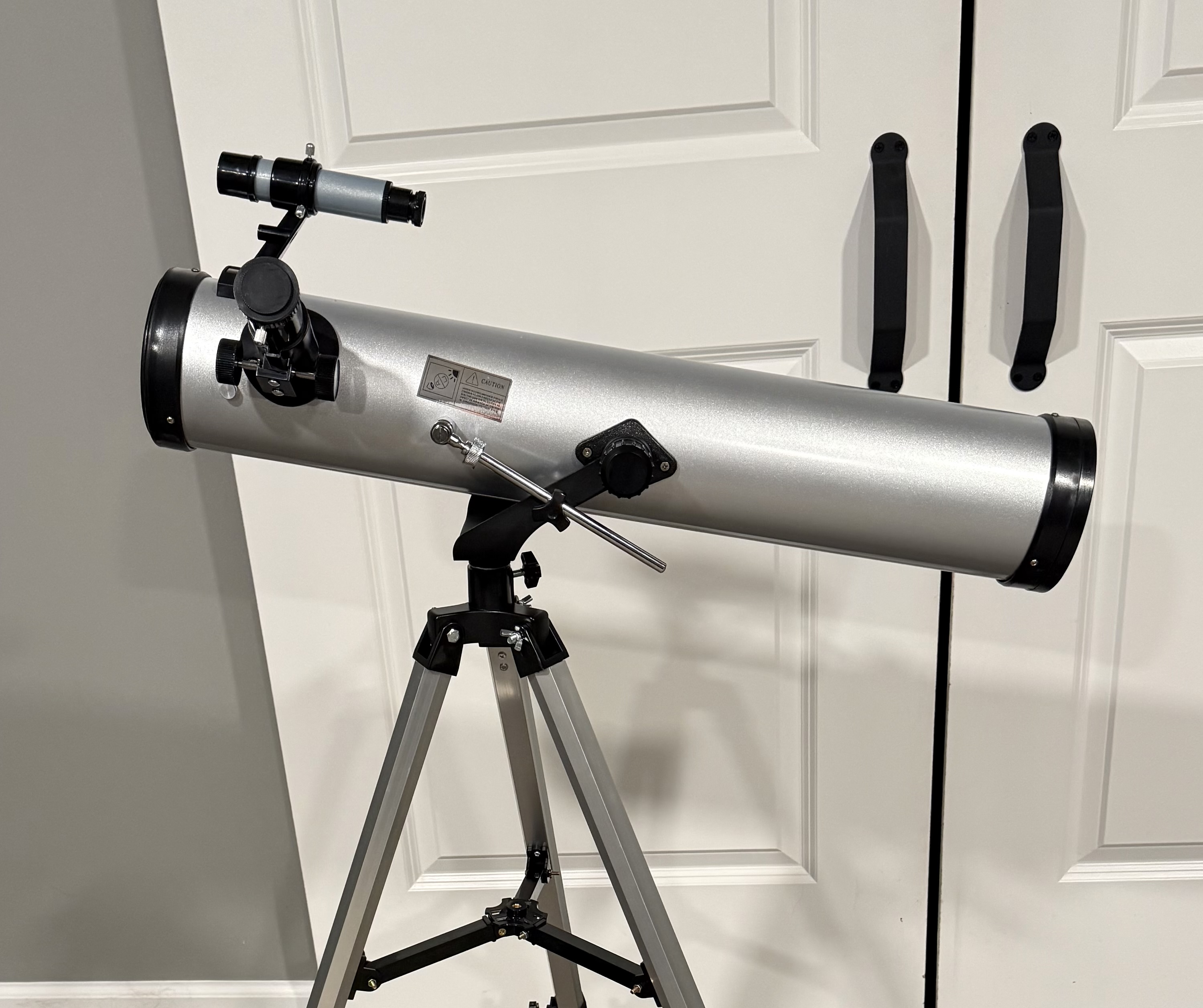
Telescope #1 "Ned"
Model Number: iMeshbean F76700
Optical Design: Newton Reflector
Aperture: 76 mm
Focal Length 700 mm
Focal Ratio: f/9.2 ("slow")
Max Useful Magnification: 152x
Max Barlow Magnification: 525x
Max nonBarlow Magnification:175x
Purpose: Planet viewer / great Moon view(photo)
Eyepiece Diameter: 0.965"/24.5mm and 1.25"/31.75mm
Eyepiece 1: H 12.5mm 700/12.5 = 56x Magnification
Eyepiece 2: H 20.0mm 700/20 = 35x Magnification (105x with 3x barlow)
Eyepiece 3: K 20.0mm 700/20 = 35x Magnification (105x with 3x barlow)
Eyepiece 4: K 10.0mm 700/10 = 70x Magnification (210x with 3x barlow - Venus/Moon)
Eyepiece 5: SR 4.0mm 700/4 = 175x Magnification (only good for viewing moon)
Mount Type Altazimuth
|
 (c) 2000-2026 by Michael Gibson. All graphics, code (php, html, css, javascript, ect.), content (unless source states other), and posts by Michael Gibson. Graphics, content and code created with GIMP, gedit, and usually vim. This page uses CSS that works on *ALL* browsers that are CSS compliant. |
 |
|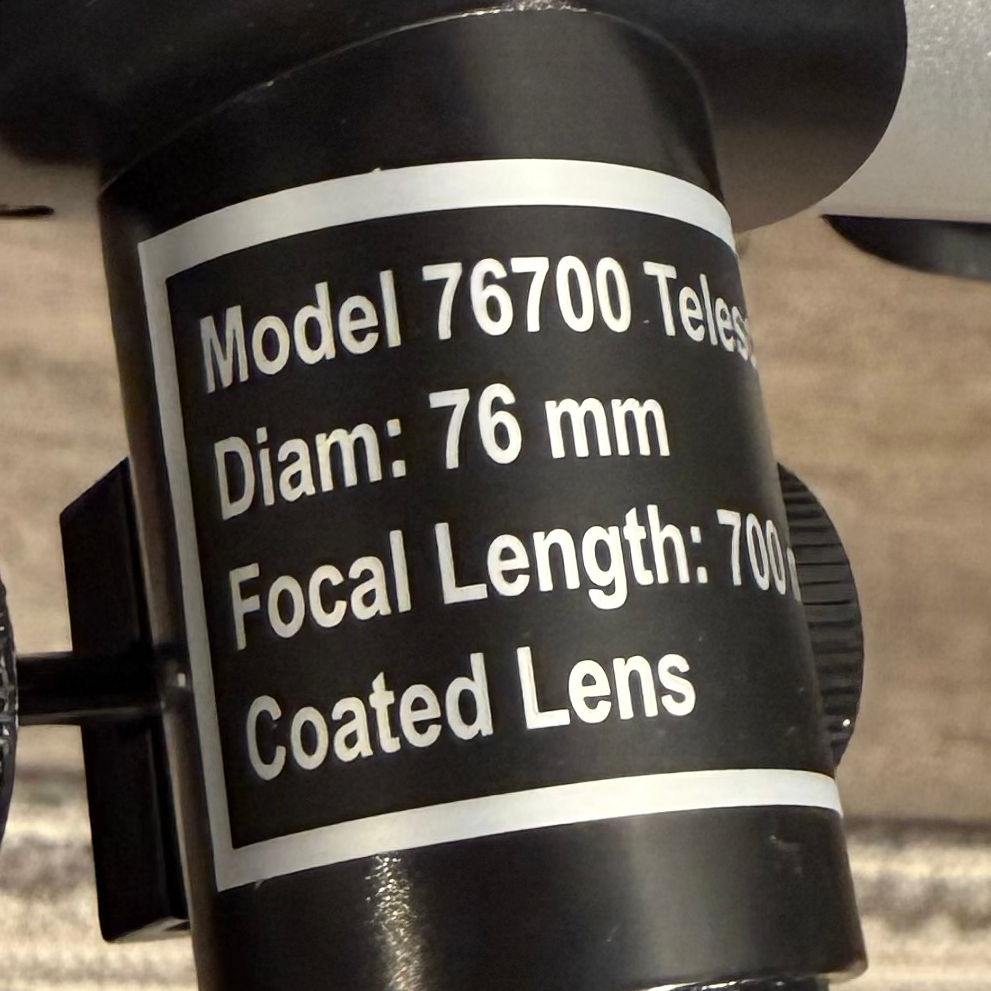 NOTE: A f/9.2 telescope is considered a "slow" focal ratio.
This optical design is well-suited for detailed views of the Moon, *very limited* planetary
surfaces like Jupiter and Saturn. My favorite Magnifications are 35x and 105x as the K20mm
lens works well with my phone camera.
----------------------------------------------------------------------
Telescope #2 "Bob"
Model Number: National Geographic NG114mm / NT114CF / 80-30114S
Optical Design Newton Reflector
Aperture: 114mm
Focal Length: 500mm
Focal Ratio: f/4.4 (fast)
Max Useful Magnification: 228x
Max Barlow Magnification: 375x
Max nonBarlow Magnification:125x
Purpose: Planet viewer / Deep Sky / Moon
Eyepiece 1: PL09.7mm 500/9.7 = 51.6x Magnification (154.8x with 3x barlow)
Eyepiece 2: K 10.0mm 500/10 = 50.0x Magnification (150x with 3x barlow)
Eyepiece 3: K 20.0mm 500/20 = 25.0x Magnification (75x with 3x barlow)
Eyepiece 4: PL26.0mm 500/26 = 19.2x Magnification
Mount Type: BRESSER 3point Pan Handle Mount
NOTE: A f/9.2 telescope is considered a "slow" focal ratio.
This optical design is well-suited for detailed views of the Moon, *very limited* planetary
surfaces like Jupiter and Saturn. My favorite Magnifications are 35x and 105x as the K20mm
lens works well with my phone camera.
----------------------------------------------------------------------
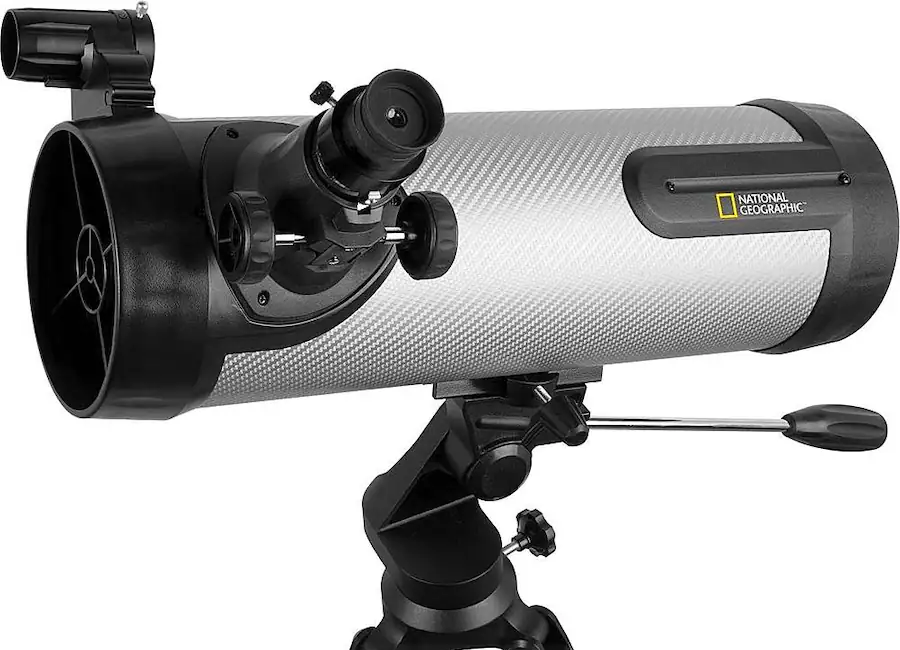
Telescope #2 "Bob"
Model Number: National Geographic NG114mm / NT114CF / 80-30114S
Optical Design Newton Reflector
Aperture: 114mm
Focal Length: 500mm
Focal Ratio: f/4.4 (fast)
Max Useful Magnification: 228x
Max Barlow Magnification: 375x
Max nonBarlow Magnification:125x
Purpose: Planet viewer / Deep Sky / Moon
Eyepiece 1: PL09.7mm 500/9.7 = 51.6x Magnification (154.8x with 3x barlow)
Eyepiece 2: K 10.0mm 500/10 = 50.0x Magnification (150x with 3x barlow)
Eyepiece 3: K 20.0mm 500/20 = 25.0x Magnification (75x with 3x barlow)
Eyepiece 4: PL26.0mm 500/26 = 19.2x Magnification
Mount Type: BRESSER 3point Pan Handle Mount
 |
| NOTE: This telescope lacks focal length to match it's Aperture Useful Magnification, so not really good for planets.
But a short focal length makes a faster Focal Ratio. With it's wider Aperture and fast Focal Ration F-number,
it is my best Deep Sky I own.
--------------------------------------------------------------------
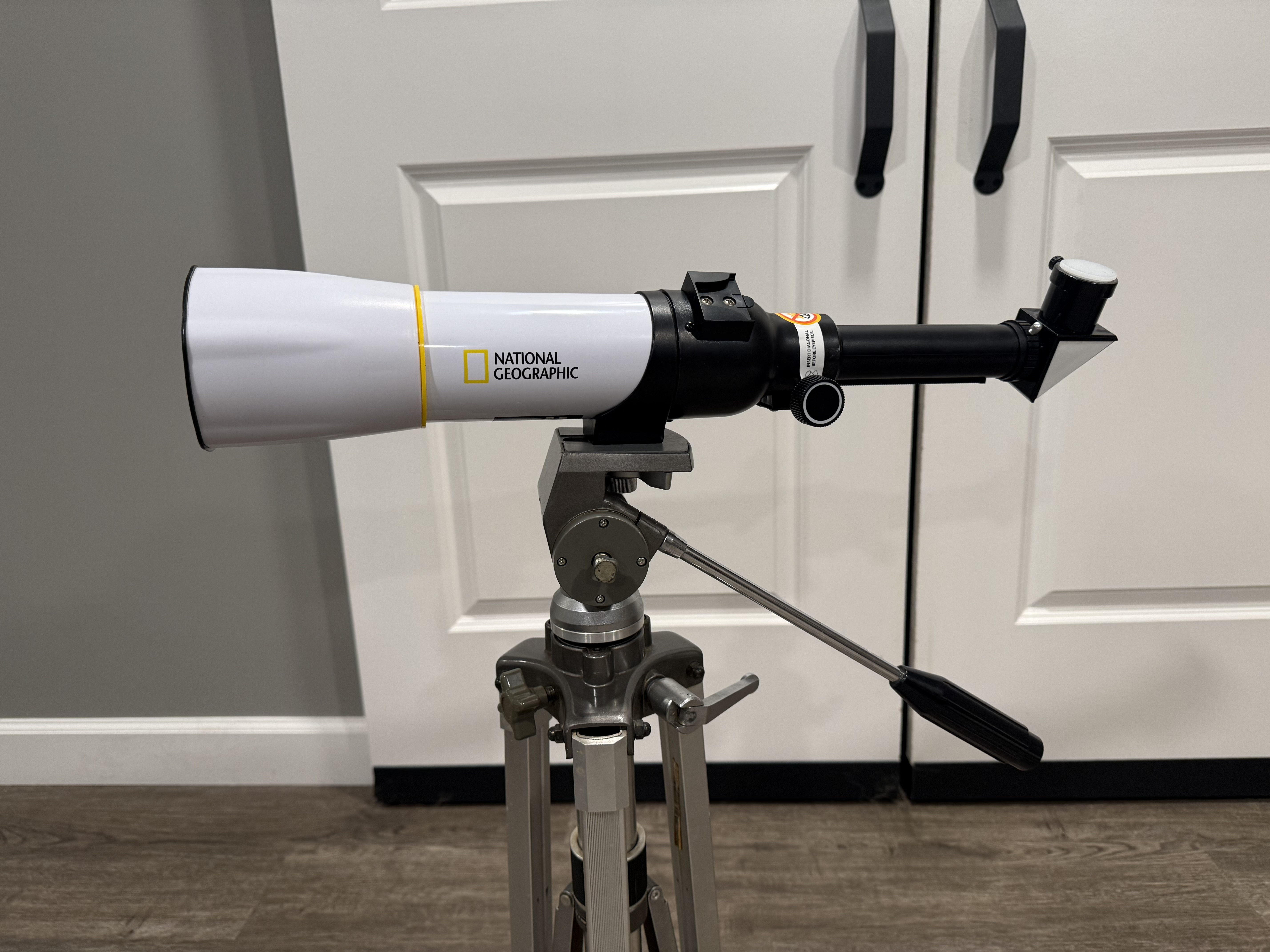
Telescope #3 "Jim"
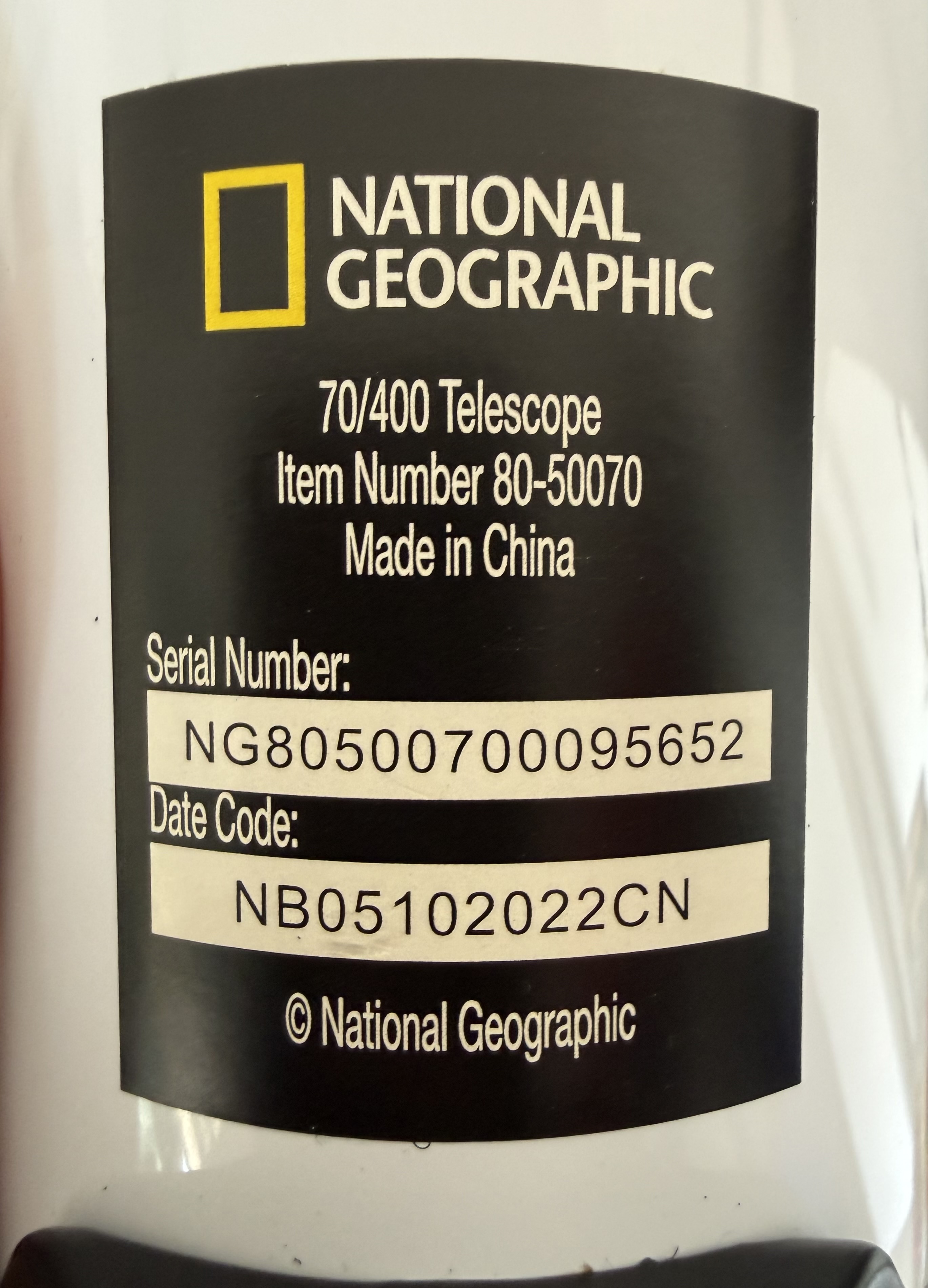
Model Number: National Geographic 80-50070
Optical Design: Achromatic Refractor
Aperture: 70mm
Focal Length: 400mm
Focal Ratio: f/5.7 ("mid")
Max Useful Magnification: 140x
Purpose: Great Moon viewer / some nebulae capable / planet capable
Eyepiece Diameter: 0.965"/24.5mm and 1.25"/31.75mm
Eyepiece 1: SR 4.0mm 400/4 = 100x Magnification (only good for viewing moon)
Eyepiece 2: K 10.0mm 400/10 = 40x Magnification
Eyepiece 3: K 20.0mm 400/20 = 20x Magnification
Mount Type: AZ Pan Handle Mount (upgraded RCA)
NOTE: This telescope lacks focal length to match it's Aperture Useful Magnification, so not really good for planets.
But a short focal length makes a faster Focal Ratio. With it's wider Aperture and fast Focal Ration F-number,
it is my best Deep Sky I own.
--------------------------------------------------------------------
Telescope #3 "Jim"
Model Number: National Geographic 80-50070
Optical Design: Achromatic Refractor
Aperture: 70mm
Focal Length: 400mm
Focal Ratio: f/5.7 ("mid")
Max Useful Magnification: 140x
Purpose: Great Moon viewer / some nebulae capable / planet capable
Eyepiece Diameter: 0.965"/24.5mm and 1.25"/31.75mm
Eyepiece 1: SR 4.0mm 400/4 = 100x Magnification (only good for viewing moon)
Eyepiece 2: K 10.0mm 400/10 = 40x Magnification
Eyepiece 3: K 20.0mm 400/20 = 20x Magnification
Mount Type: AZ Pan Handle Mount (upgraded RCA)
 |
| NOTE: A f/5.7 telescope is a versatile "mid-speed" focal ratio.
This optical design is ideal for wide-field visual observing of *non-detailed* views of nebulae and deep-sky.
Because of small aperture, great detailed views of the moon.
I have only used this telescope to look at Jupiter and it's moons, Venus, and the Moon.
NOTE: A f/5.7 telescope is a versatile "mid-speed" focal ratio.
This optical design is ideal for wide-field visual observing of *non-detailed* views of nebulae and deep-sky.
Because of small aperture, great detailed views of the moon.
I have only used this telescope to look at Jupiter and it's moons, Venus, and the Moon.