


 and Chasing Jupiter from my Yard.
  Back to MrGibson HOME
| and Chasing Jupiter from my Yard. |
Back to MrGibson HOME |
|
Picking a telescope Advantages and Disadvantages of Telescope Types
Aperture - What diameter do you want on a telescope? Simple. No matter the type or the purpose of your telescope, buy the biggest Aperture you can afford. But not so big it creates issues. The bigger the aperture, the more light gathered and this will create better views. The moon is usually the exception for light gathering needs. What Is Telescope Aperture? The aperture of a telescope is the diameter of its primary optical element. In a refractor telescope, it’s the diameter of the lens; in a reflector telescope, it’s the size of the mirror. This measurement, usually given in millimeters or inches, sets the foundation for what the telescope is capable of. In general, the more aperture the better, but larger telescopes come with added challenges and cost. A beginner refractor usually have a 70mm to 90mm aperture. A mid-sized Dobsonian (reflector) telescope may feature a 200mm (8-inch) mirror. Unlike magnification, which can be changed with different lens eyepieces, aperture is fixed and directly tied to performance. Large apertures are highly beneficial for viewing detail and photographing planets, nebulae, or galaxies. Aperture affects two essential qualities: A larger aperture collects more light, making faint galaxies, nebulae, and star clusters visible. For deep-sky observing and astrophotography, this is critical. The wider the aperture, the finer the details you can resolve. This means sharper views of lunar craters, the cloud bands of Jupiter, or the spiral arms of galaxies. Below breaks down what different Apertures can show you, or what you can expect to see at common aperture sizes. Here are five main aperture classes of hobby telescopes:
Knowing what I know now: - 114mm Aperture is needed for anything more than great moon viewing. - 130mm Aperture if you want to see any detail in a Nebula. - 150mm Aperture if you want to see any real detail in anything. - 200mm Aperture, just know it will cost you alot. f-Number - what f-Number do you want with a telescope? This depends on how you wish to use your telescope. There is not a telescope that is great at all things. Some may be great at faint deep space objects. Some may be great at viewing planets. Some might try to be able to do both, but not excel to the same degree at either. The f-number (or focal ratio) on a telescope is the ratio of its focal length to the diameter of its aperture (light-gathering lens or mirror). It is usually written as f/N (e.g., f/5 or f/10) and dictates the optical system's "speed". The f-Number can be broken into three catagories. Fast, mid-range, and slow. f/2 is very fast, f/6 is a mid-range speed, and f/15 is extremely slow. Most telescopes have a purpose and range of use. Some telescopes are better for faint galaxies and nebulae, while others are better for planets. To find the f-number:
          N  =  Telescope Focal length (mm)
                   Aperture diameter (mm)
Where:N = Focal ratio (often written as f/N ) Lenses - what lens diameter do you want on a telescope? There are four different lens diameter standards. but millimeter for lens focal length. Today, the 1.25-inch is the most common (from beginner to mid-advanced) and the 3-inch is the least common. Unless you have money burning a hole through your pocket, you should avoid the telescopes that use 3-inch lenses. What visual wide-field you gain, versus the price, you are better off with the 2-inch lens telescopes. Unless you have no money to spend on this hobby, avoid the 0.965-inch lens telescopes. Quality of view suffers a bit. I have two telescopes that by default use the two diffrent lense diameters. With an adapter, they both can and do use 0.965-inch and/or 1.25-inch lenses. I definetly have a preference, and I found amost everyone else does too. My first telescope, and the last telescope I purchased, came with 0.965 (24.5mm) lenses. I also have a National Geographic that came with a 1.25-inch / 31.75mm lenses and you can really see the difference. 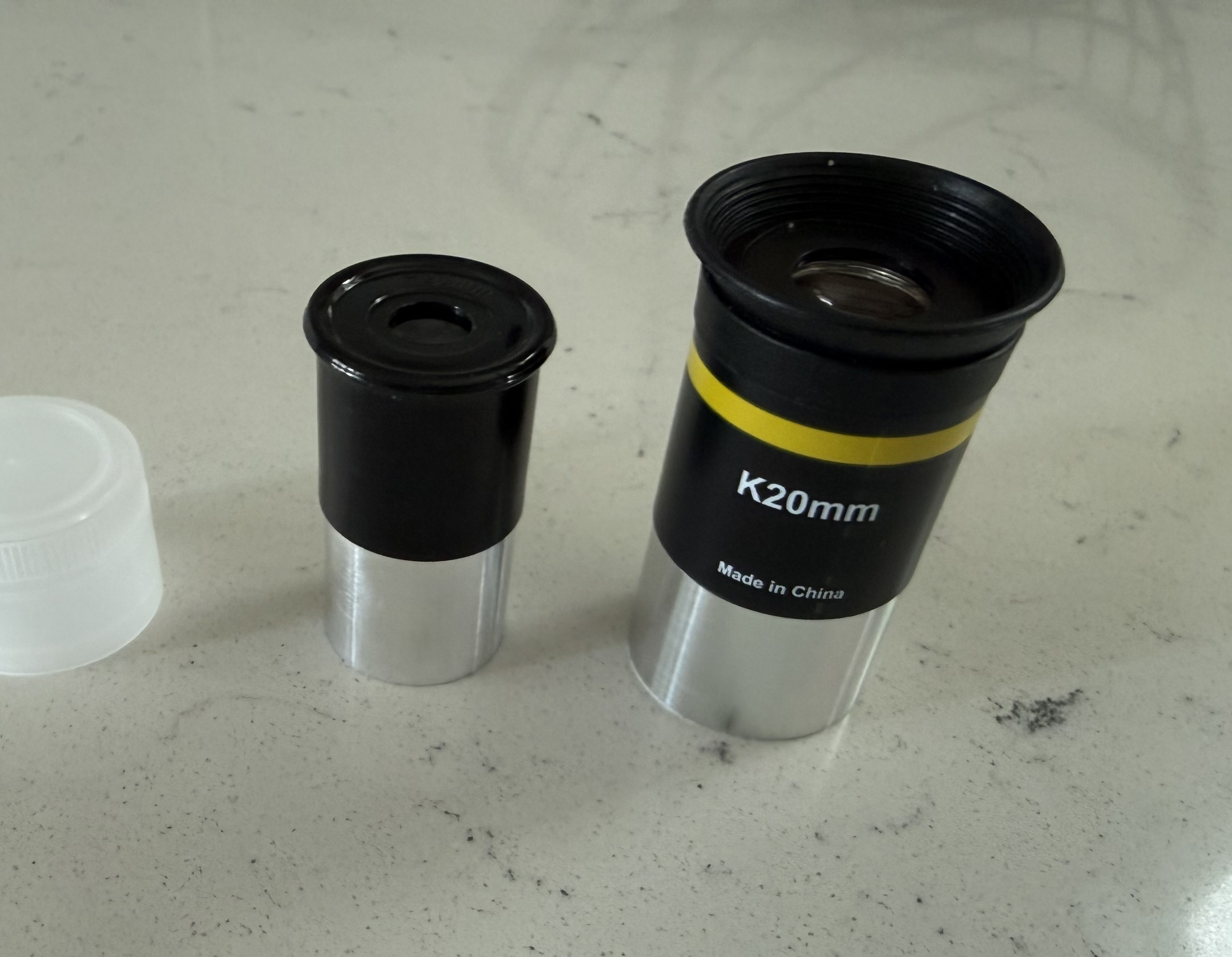 Photo of my .0965 diameter/20mm focal lens next to my 1.25 diameter/20mm focal lens. For astronomical telescopes, my opinion, and the majority opinion, a 1.25-inch (31.75) lens (or eyepiece) diameter is significantly better than a 0.965-inch (24.5mm) diameter. The 1.25-inch size is the most common modern industry standard, offering very good optics, a wide field of view, and access to thousands of standard upgrades. Here is a breakdown of the differences and highlights of why the 1.25-inch is the superior choice over the 0.965-inch: 1.25-Inch / 31.75mm Standard: manufactured in the 1.25-inch size. are usually made of lower-quality plastic and glass. 0.965-Inch / 24.5mm Standard: through a straw. made in this size. Have a 0.965? There is hope! What to check next: If your telescope is equipped with a 0.965-inch focuser, you aren't completely out of luck. You can often buy a 0.965" to 1.25" adapter Sometimes this adapter is called a hybrid diagonal. the adapter just slides into your old focuser, allowing you to use modern, higher-quality 1.25-inch eyepiece lens. Is photography going to be your primary use? Use should consider a telescope that uses 2-inch lenses. |
 (c) 2000-2026 by Michael Gibson. All graphics, code (php, html, css, javascript, ect.), content (unless source states other), and posts by Michael Gibson. Graphics, content and code created with GIMP, gedit, and usually vim. This page uses CSS that works on *ALL* browsers that are CSS compliant. Like FireFox, Chrome, Edge, and Safari. Moving code to PHP 8.x You are using Mozilla/5.0 AppleWebKit/537.36 (KHTML, like Gecko; compatible; ClaudeBot/1.0; +claudebot@anthropic.com) |